


The gig diseconomy: parasites are killing freelance marketplaces


Saturday morning, breakfast, and naturally, I’m scrolling YouTube.
I stumble across a video that breaks down the slow financial collapse of Upwork and Fiverr.
Business has gone horribly wrong since the end of the COVID pandemic, and stock prices are down ~90% from their highs.
As I watch their demise unfold over my rolled oats, a thought grabs me, and I open Ahrefs. I want to see if their financial declines are in any way tied to a drop in traffic.
Spoiler: I couldn’t draw a conclusive, clean line from the stock price to any of this (AI and bad business decisions are likely behind that, a separate rabbit hole), but what I find is far more interesting than just falling stock prices and traffic decline.
There’s serious SEO f$#kery afoot, and my goodness, it’s oh so spicy.
I spent a weekend in Ahrefs out of pure, unadulterated distaste
So, I have this streak in me. If I feel slighted in any way, feel wronged at all, I like to revel in my enemy’s downfall… even if it’s years later. Truth be told, in a past life, I had freelanced on Upwork and Fiverr, and I’ve never forgiven either for their exploitative fee structure.
So what started as a touch of leisurely Saturday morning research, motivated by pure vindictiveness, quickly uncovered something HUGE.
It started with just Upwork and Fiverr, but as I dug deeper, I also investigated other freelancing marketplaces.
In the end, I put five freelancing marketplaces under the microscope, including Upwork, Fiverr, Freelancer.com, PeoplePerHour, and Contra. For each platform, I pulled the data back to 2019, through each company’s IPOs (if they had one) and the COVID boom, to make sure I wasn’t cherry-picking a window.
For most of that history, pages and traffic moved together in ways that make sense. Then, starting in early 2025, that stops. Organic traffic across the five platforms fell 30% to 60% between early 2025 and mid-2026.
Not great, but things get worse.
Across all five platforms, the number of pages ranking in Google’s top 100 collapsed by 90% or more over the same window. Upwork went from 242,309 indexed pages in January 2025 to 13,358 by July 2026.
Fiverr peaked at 1,712,113 pages on March 4, 2024, likely due to a programmatic content push, and fell to 19,612 pages by July 2026. Freelancer.com, PeoplePerHour, and Contra all show the same pattern: a page count that fell at twice or three times the rate of traffic.
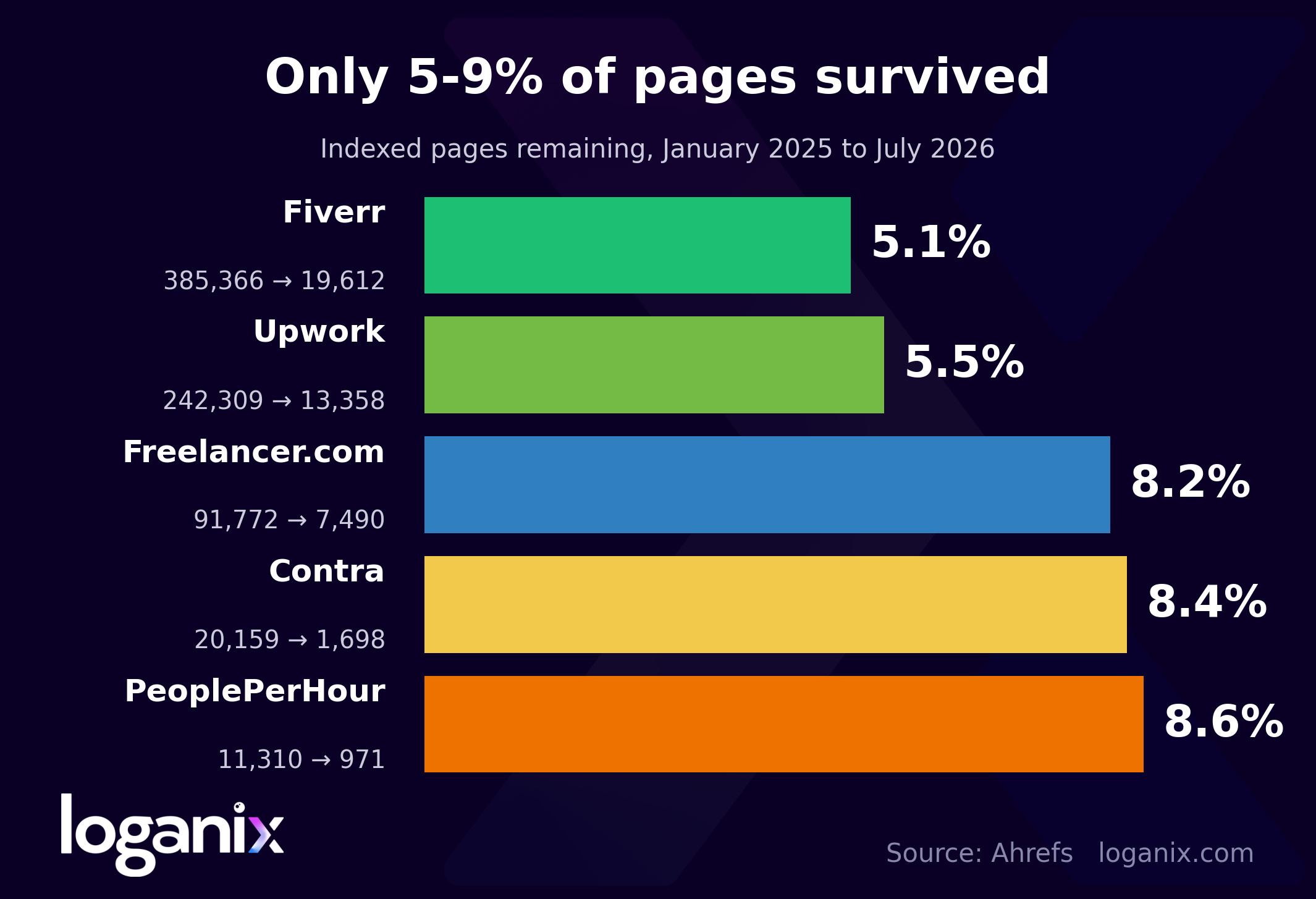
So where did the other 60-odd percent of pages go, if the traffic drop doesn’t account for it?
This is where things start to get interesting. It means Google not only deprioritized these platforms but also removed pages from the index at a rate that demand decline can’t explain, which points toward something more specific: enforcement, not attrition.
Here’s exactly what got deindexed
I pulled the specific pages that disappeared, ranked by how much traffic they used to carry. The pattern across platforms is remarkably consistent and not at all subtle.
Freelancer.com’s single highest-traffic lost page peaked at 4,273,464 monthly visits in late October 2024, an explosive, near-vertical spike from almost nothing in about a week, before decaying steadily and finally getting wiped out entirely by February 2025.
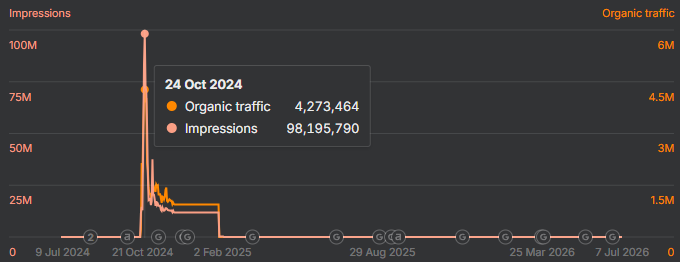
Here’s a sneak peek at the keywords it was ranking for. Just look at those monthly organic visitors. Absolutely insane!
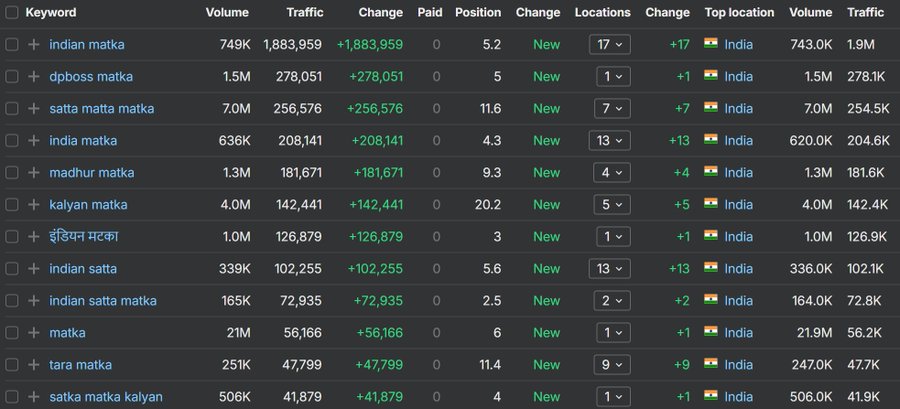
Here’s what the snapshot Wayback Machine took of this page:
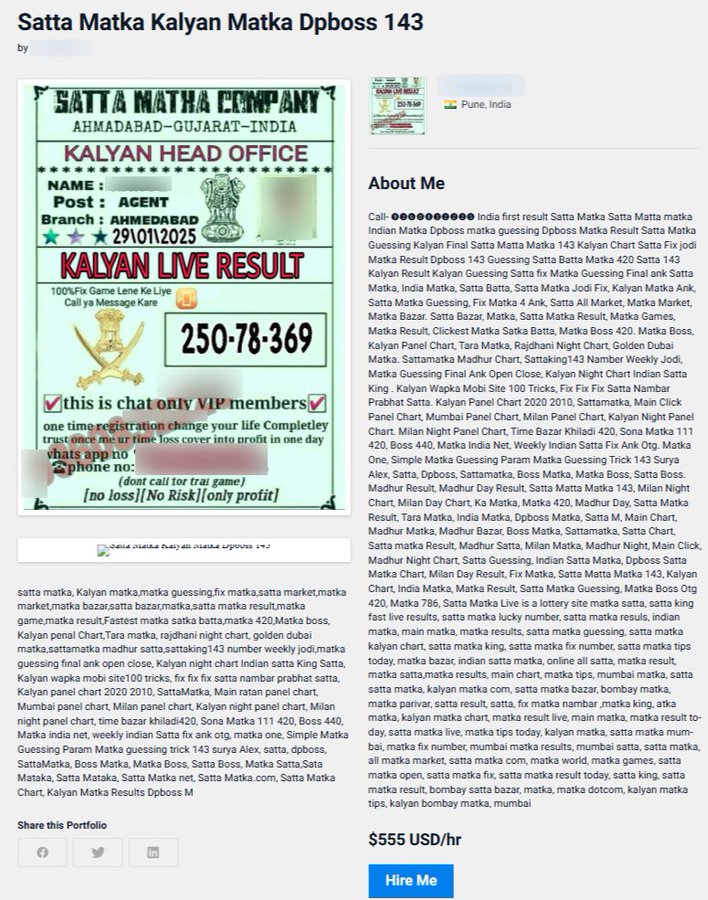
If you’re wondering, Satta matka is a decades-old, illegal Indian numbers-betting racket, forced onto phone and WhatsApp tipster networks precisely because it can’t operate in the open.
Everything on this page is a betting-tout funnel dressed as freelance work: the “Kalyan Live Result” graphic, the WhatsApp number, the “no loss, no risk, only profit” pitch.
Even the wall of text under “About Me” isn’t written for a human to read. It’s every spelling variant of “satta matka,” “kalyan matka,” and “dpboss” crammed into one paragraph, an old-school keyword-stuffing trick aimed at Google, not at anyone hiring a freelancer.
And that’s the entire scheme: borrow Freelancer.com’s domain authority, stuff the page with betting keywords, funnel anyone who lands on it to a WhatsApp number. Multiply that by a few hundred near-identical accounts, and you get a single page worth 4,273,464 monthly visits.
Dude, this is the freakin’ parasite of all parasites. I tip my black hat to you, sir.
Upwork’s lost pages tell an even messier story. Its single highest-traffic loss was a freelancer profile that spiked to 471,280 monthly visits in early January 2025.
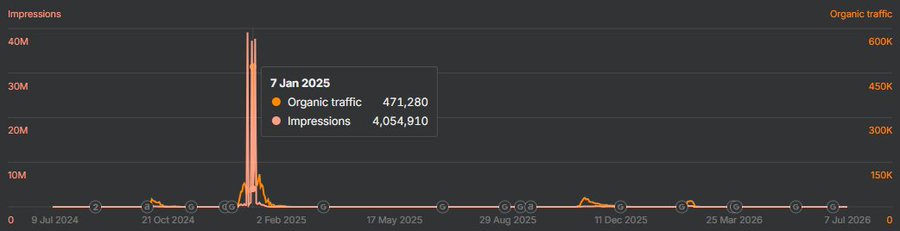
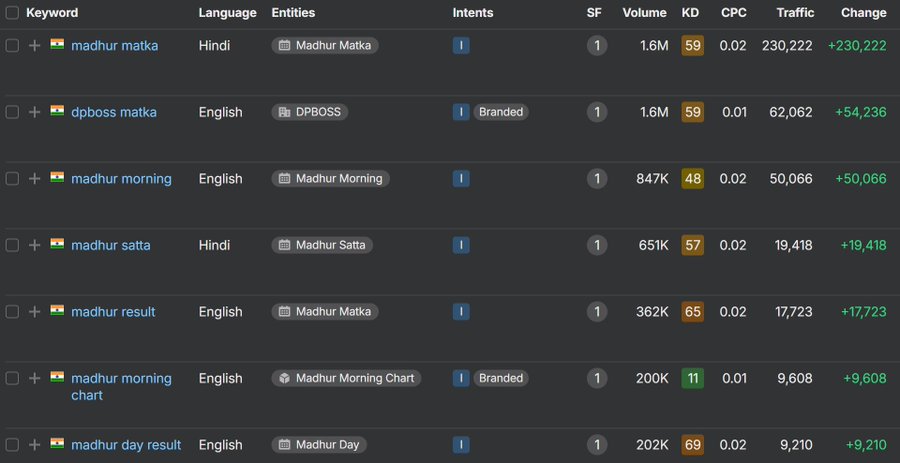
The page was ranking primarily for “madhur matka,” the same gambling racket found crawling all over Freelancer.com. Unfortunately, this time, the Wayback Machine hadn’t captured a snapshot of the page, but here’s what it was ranking for at its peak:
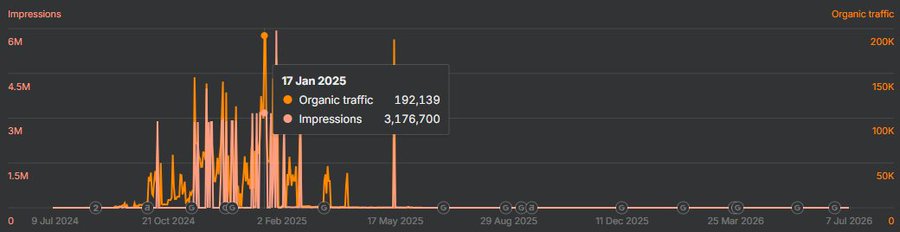
Also on Upwork, a website-development gig openly advertised for building sites for Tiranga, 91 Club, Goa Games, and Daman Game, all known illegal betting platforms in India, which peaked at 192,139 visits.
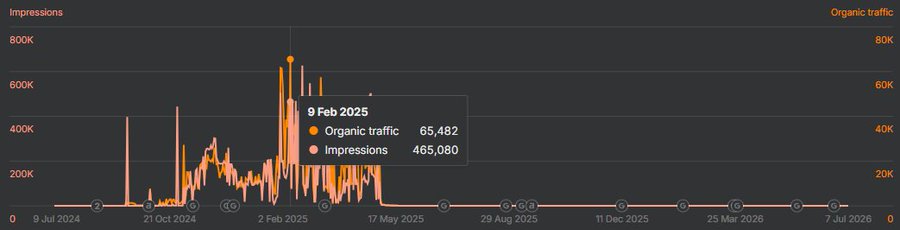
An agency page ranking for the keyword “xxxwww” topped out at 65,482 visits, adult-content bait with nothing to do with freelance work.
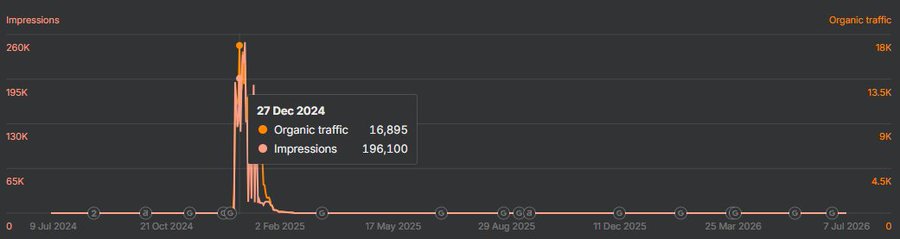
And an “aviator predictor” gig, selling a bot that claims to predict outcomes on a popular betting game, peaked around 16,895 visits.
PeoplePerHour’s version is the most blatant of the five. Take the listing ranking for “guest post on internetchicks.co.uk”: 15 bucks buys a “Featured Article,” pitched by a seller in India.
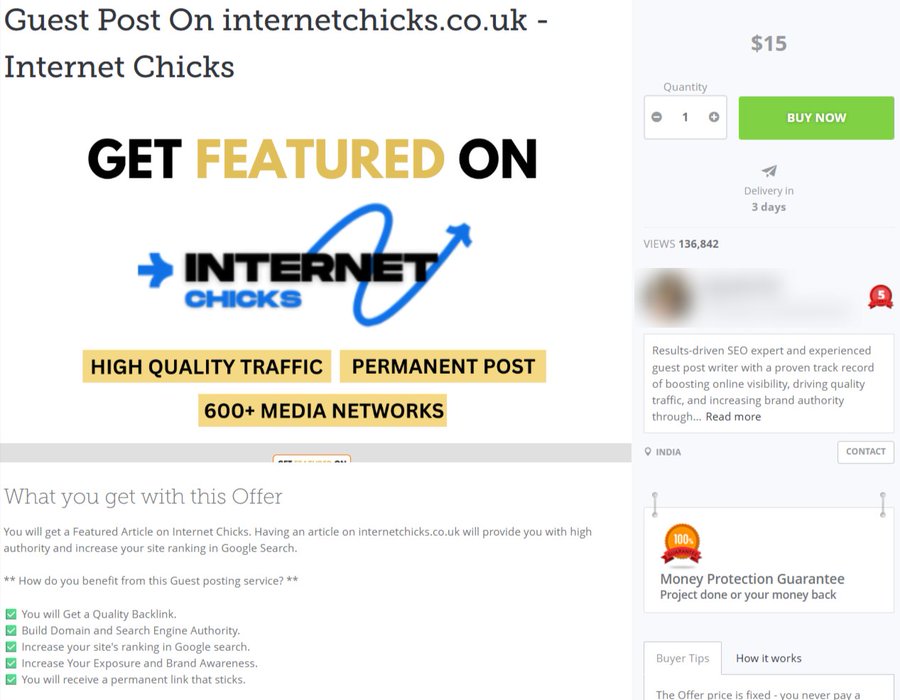
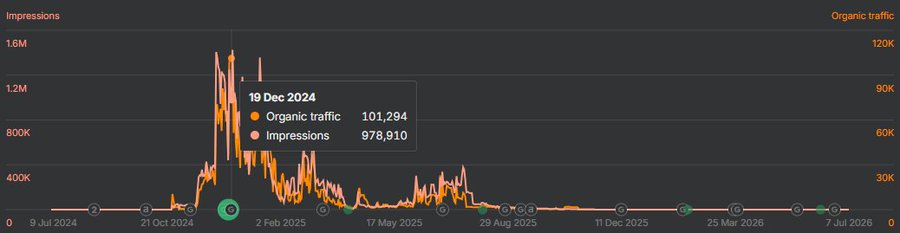
It racked up 136,843 views and peaked at over 102,000 monthly search visits in December 2024, before dropping out of Google’s results entirely.
Contra’s version looks different again, and smaller. Its lost pages include off-topic AI-generated listicles and pages promoting online betting brands like Gold365 and HitnSpin, but none of them pulled more than a few thousand monthly visits at their peak.
This is still happening, right now, just not on the same scale
Here’s the interesting part: On three of these five platforms, the spam is still present, but it’s significantly toned down.
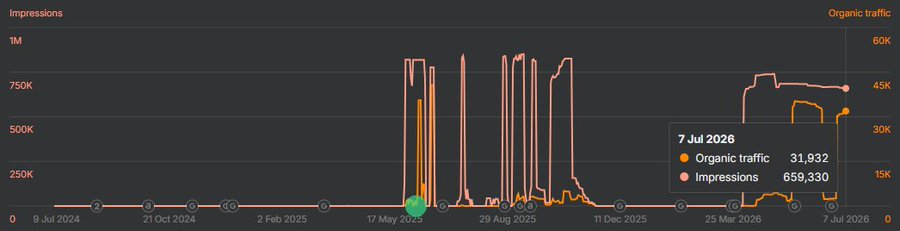
Pull PeoplePerHour’s current top pages by traffic, and its #2 and #3 highest-earning pages, right behind the homepage, are guest-post-spam gigs. Live, ranking, and earning the platform money today.
One of the pages leads to veganovtrichy.com, a website that heavily promotes online gambling and igaming.

The page that’s currently attracting 31,932 monthly visitors:
Contra’s current #2 traffic page is “aladin66_login,” a login page for an Indonesian betting brand, sitting above Contra’s own “find freelance jobs” feature page.
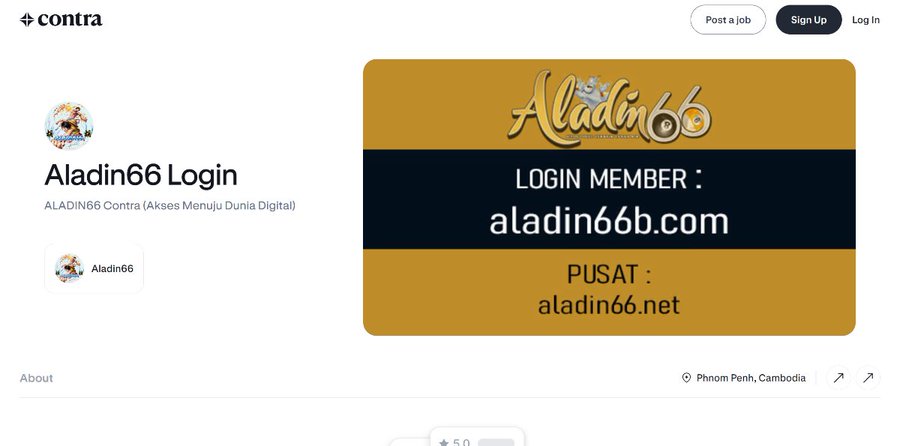
All you have to do is click on a link from the profile, and you’ll soon find yourself here:

Upwork, Freelancer.com, and Fiverr, by contrast, look genuinely cleaned up now. Very likely because they got a rap on the knuckles by Google, which I’ll cover very shortly.
But first, backlinks
The obvious next question: did someone build a wave of spammy backlinks to force all this ranking, and did Google’s crackdown target those links?
I checked. The answer is no, mostly, and the “mostly” is the interesting part.
Referring domains across all five platforms grew steadily throughout the entire window I tracked. Upwork’s referring domains climbed from 40,000 to 104,000 between 2020 and 2026 without a single interruption. Nearly every individual spam page I identified had zero referring domains of its own.
That’s worth sitting with for a second. These pages weren’t ranking because someone built links to them. They were ranking because they were published on a domain that already had authority, and that was enough.
These were true parasite SEO plays.
Contra is the outlier. Its referring domains grew 2.5 times over, from 4,526 to 11,582, in the exact same window, its pages collapsed 93%.
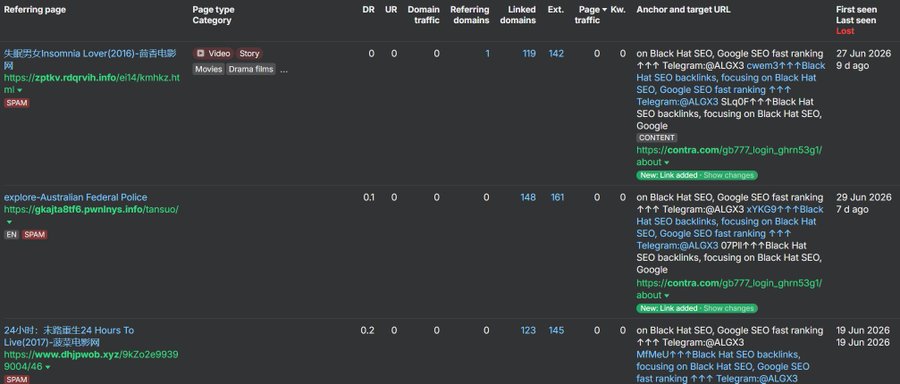
I checked what’s actually driving that growth, and it’s an active link-injection campaign, happening right now. Pulling Contra’s most recent backlinks turns up pages that are all picking up fresh links from junk domains with essentially zero authority, dated within the last 24 hours.
The anchor text gives the whole game away: “Black Hat SEO backlinks, focusing on Black Hat SEO, Google SEO fast ranking, Telegram:@ALGX3.” Someone is running a live link-selling operation straight into Contra’s gambling pages and advertising the service in the links themselves.
Google says, “F this. Enough already!”
On May 5, 2024, Google’s site reputation abuse policy officially took effect.
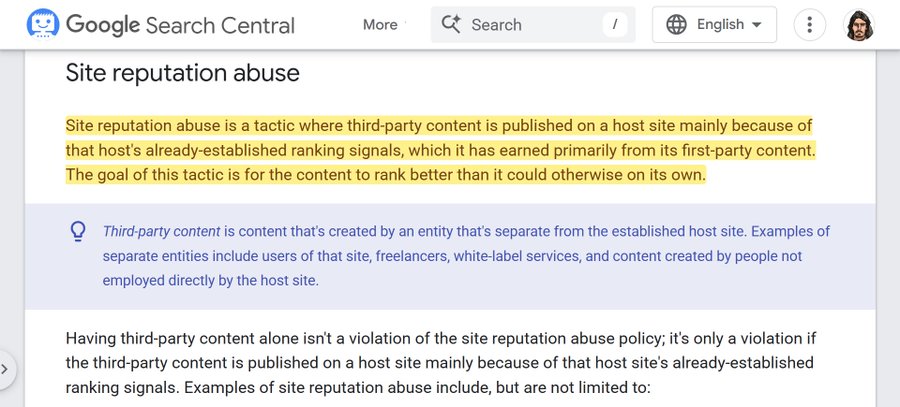
The policy went through four distinct moments:
- Announced in March 2024, as part of that month’s core update, alongside two other new spam policies (expired domain abuse and scaled content abuse).
- Took effect May 5, 2024.
- Its first-party/white-label loophole closed on November 19, 2024.
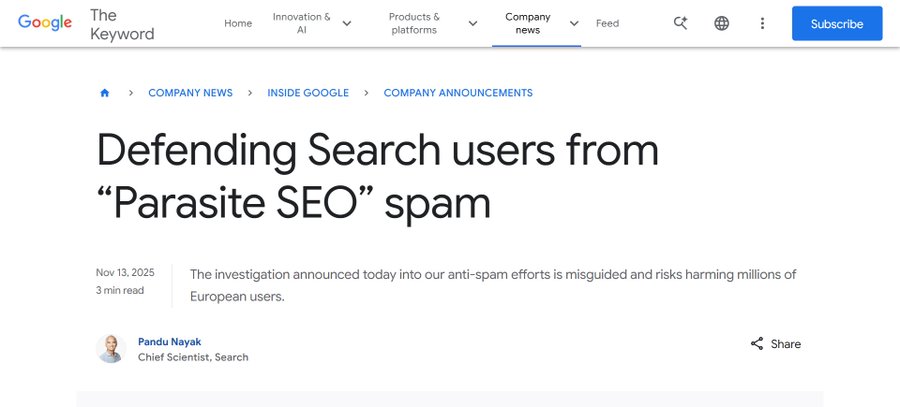
- Publicly re-defended by Google’s chief scientist for search on November 13, 2025, in the middle of an EU antitrust investigation into the policy itself.
Line those four dates up against what actually happened to each platform’s pages, and the picture is messier than a single clean correlation, which is exactly what makes it convincing.
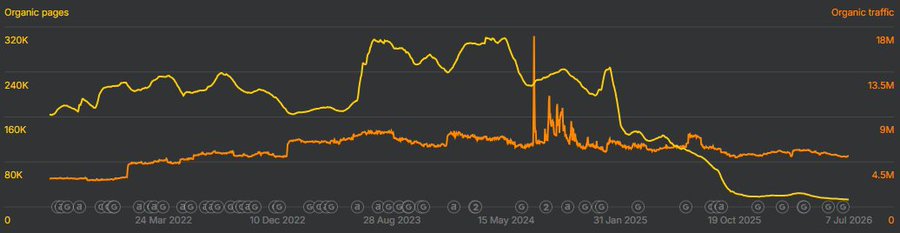
Upwork fits the timeline almost perfectly. Pages fell 26% in the three months after the policy took effect (292,309 to 215,314, May to July 2024), fell again in the same month the loophole closed (240,785 to 217,811, November 2024), then lost 40% of what remained in a single month in February 2025 (242,309 to 145,330), the steepest one-month drop in the platform’s history.
There was a clear spike around June/July of 2024, but aside from that, traffic remained relatively stable.
Fiverr’s decline starts earlier, right at the March 2024 announcement rather than the May effective date, and it’s severe: a 67% page loss in four months (1,712,113 down to 573,485, March to July 2024).
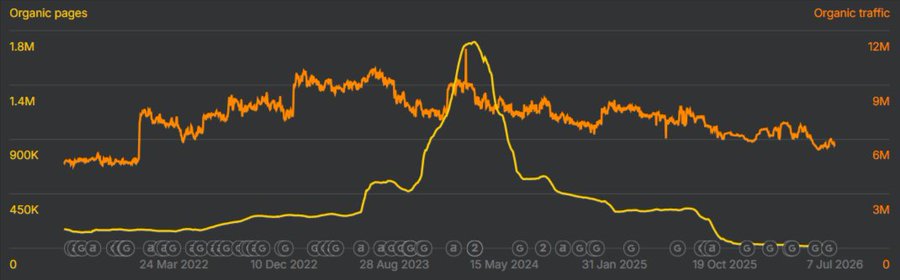
That timing points more toward the scaled content abuse policy announced the same month; Fiverr’s page peak was a “programmatic content push,” exactly the kind of mass-produced content that policy targets, not the third-party-hosting mechanism site reputation abuse addresses.
Fiverr shows no dip around the November 2024 update, and its own catastrophic collapse doesn’t land until September through December 2025.
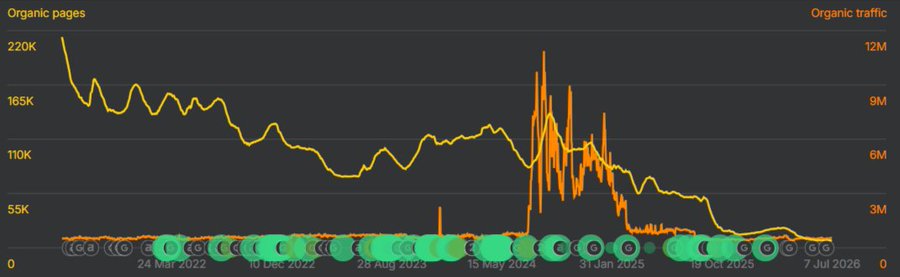
Freelancer.com doesn’t track any of these dates cleanly. Its 2024 story is a traffic spike, not a pages story, driven almost entirely by that single gambling portfolio page, which peaked at 4.27 million visits in October 2024. Its pages didn’t start a sustained decline until January 2025, building gradually before a sharp 43% single-month cut in October 2025 (48,105 to 27,563).
I’m not claiming Google confirmed a manual action against any of these platforms by name. Nobody has, and I’m not claiming every platform got hit by the same mechanism on the same day.
What I am saying is that the data shows three different platforms losing pages at three different rates, each one tracing back to a real, dated Google spam-policy event rather than to anything resembling a demand slump.
To get somewhat of a reference point, I checked two large UGC platforms outside the freelance category, too, Indeed and Yelp, and both show the same shape of pages collapsing over the same window. Whatever this is, it’s bigger than freelance marketplaces. They’re just one of the most obvious, but less-reported examples of it.
The conflict of interest nobody’s covered until now
Every existing write-up of parasite SEO uses a media company as the example: Forbes Marketplace, a local newspaper, or a magazine that took a sponsored post. In those cases, a media executive negotiated one deal, once, with someone who wanted to borrow the site’s authority.
Freelance marketplaces are a different animal entirely. Nobody negotiated anything. A platform’s own paying customers listed the abuse as a product, thousands of times over, and the platform took a cut of every sale.
Upwork and PeoplePerHour both earn a direct commission on the guest-post and backlink-selling gigs I found in their own marketplaces. That’s the same mechanism as classic parasite SEO, run retail instead of wholesale, and sold by the host itself.
Cleanup was never going to be fast. The platform responsible for taking spam down is the same platform that gets paid every time someone buys it, and on two of these five sites, that arrangement is still live, right now, while you’re reading this.
Strip away two years of “market conditions” talk, and this is what’s sitting underneath: these platforms didn’t get caught in someone else’s spam campaign. They built the shelf, stocked it, and rang up the sale.
Host authority is only worth as much as a platform’s incentive to protect it. When the platform gets paid either way, turning a blind eye is bought and paid for.
Anyway, here’s to Saturday mornings and spite as a legitimate research methodology.
Written by Brody Hall on July 22, 2026
Content Marketer and Writer at Loganix. Deeply passionate about creating and curating content that truly resonates with our audience. Always striving to deliver powerful insights that both empower and educate. Flying the Loganix flag high from Down Under on the Sunshine Coast, Australia.